Form Follows Fuel: Event write-up
Caitlin Arbuckle-MacLeod reflects on the latest in the Authors of Urbanism series

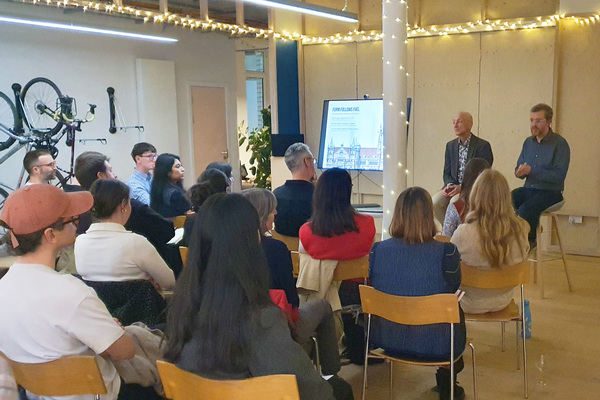
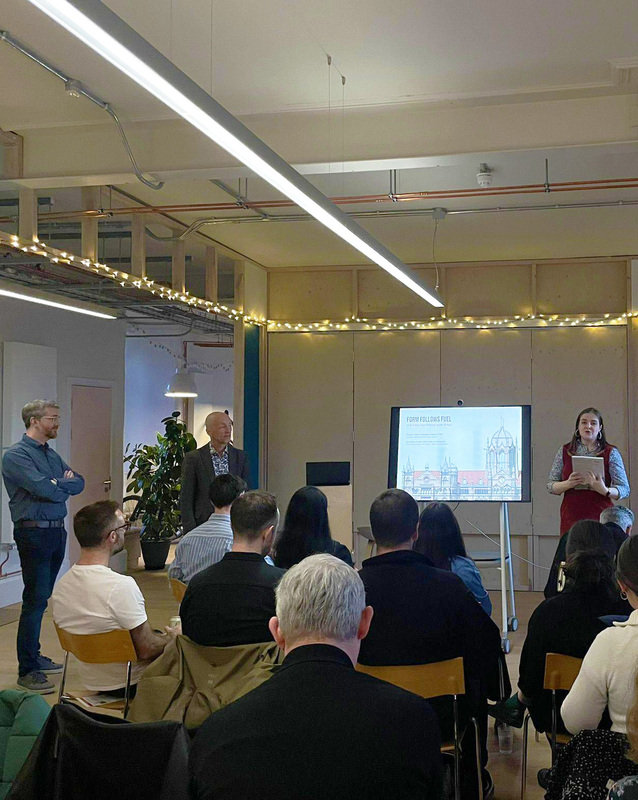
On the evening of Wednesday 18 March, we held the third Authors of Urbanism event at Collective Architecture’s Glasgow studio, a young series dreamed up by the Scottish Activities Group which has so far been encouragingly well attended and very positively received by the Scottish contingent of the AoU community. This time we welcomed Barnabas Calder (historian of architecture and energy, and senior lecturer at the University of Liverpool) and Florian Urban (architectural historian, Professor of Architectural History and Head of History of Architectural and Urban Studies at the Glasgow School of Art) to discuss their 2025 book Form Follows Fuel: 14 Buildings from Antiquity to the Oil Age, which is claimed to be the first book ‘to quantify energy inputs for a range of buildings worldwide and across the historical record’ in order to demonstrate that ‘energy has been the biggest influence on the world’s architecture throughout the history of our species.’
Urbanists with less of a particular architectural leaning need not be daunted by this technical-sounding mission statement. In their hour-long presentation, Calder and Urban take the audience on a journey from the details of their rigorous methodological process in energy quantification to the principled heart of their work, which calls for a rejection of over-consumption, of ‘accumulating stuff,’ and the embrace of life’s simpler, purer pleasures, such that anyone in attendance (regardless of professional background) can connect with their message. This may give the impression that the discussion is admonishing or sanctimonious in tone; on the contrary, Calder opens by clarifying that, far from wishing to ‘depress audiences’ and chastise them for complicity in climate breakdown, he and Urban want to celebrate ‘human ingenuity’ and the fact that, as attendees of the event, we have chosen to use our time to engage with, rather than ignore, the important issues.
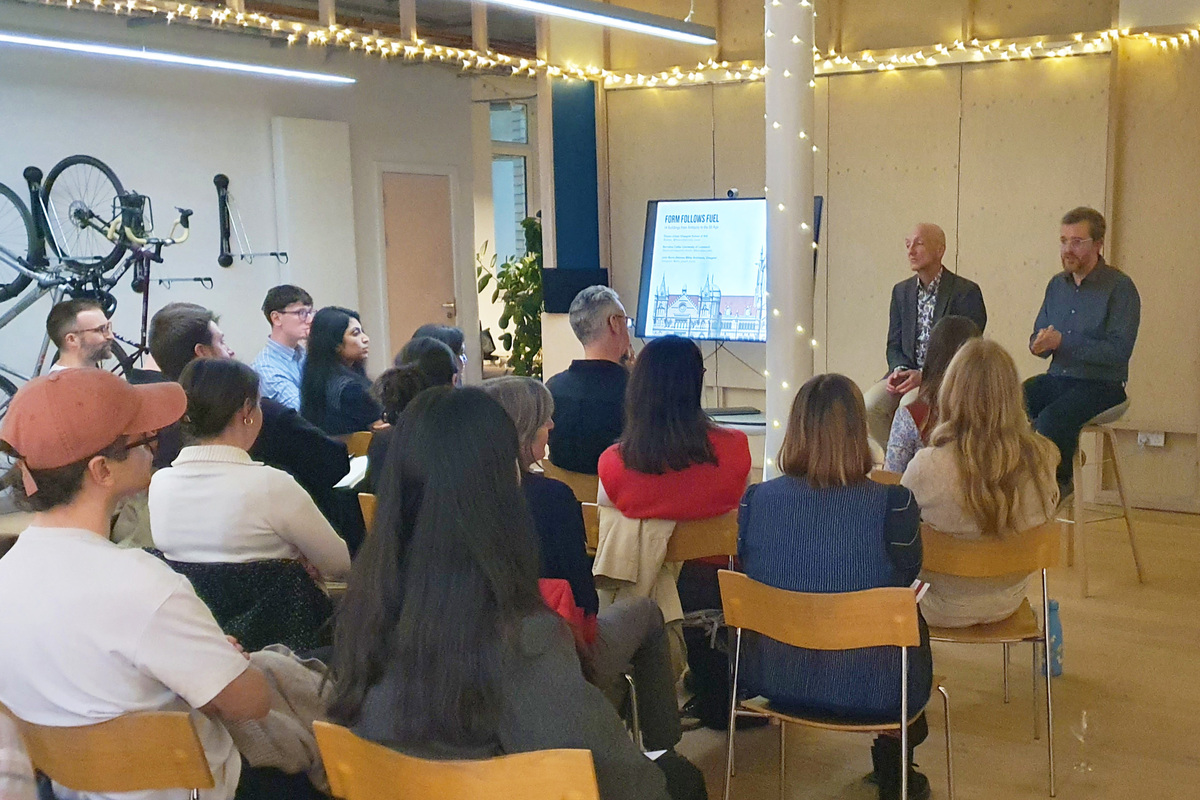
In discussing their work, the duo gives the practitioners in the room plenty of food for thought. For example, Urban explains, the central methodological mechanism of the book involves calculating embodied and operational energy for 14 buildings spanning a variety of time periods, geographies, styles, and ‘fuel regimes.’ The authors argue that this the more valuable metric to measure the environmental harms of built environment processes over (or at least, alongside) assessment of carbon figures, which are prone to manipulation, opacity, and which lack the consistency across time and geographical locations that energy figures possess; Urban uses the example of aluminium, which is very energy intensive to produce, but may appear deceptively ‘green’ due to its low carbon emissions figures.
Far from being an exercise in pure semantics, this approach leads to broader reflections on ‘greenwashing’ in the built environment, and the ways in which we have inherited from ‘generations of people’ a way of life and of building which is, on the whole, unsustainable, despite our best attempts to make it appear not so. Calder highlights the ways in which, since the dawn of coal power (which ushered in a ‘new architecture’, as ‘form follows fuel’), energy (over)consumption has been bound to explicit displays of wealth, from the windows of Georgian houses to the excessively large cars we drive today. He zooms out even further, arguing that the very metrics we use to measure wellbeing across the globe conflate over-consumption with progress and human happiness, and that this is further weaponised by western political leaders who attempt to declare superiority over poorer countries who consume less: ‘simplicity is treated with contempt,’ says Calder, urging us to ‘test what you really need, get by on less, and adopt true sustainability this way’ instead.
Calder’s arguments are impassioned, provocative, and occasionally startling – Elon Musk appears on screen for a brief moment: ‘is this the happiest person on earth?’ – but grounded in a rigorous base of research and an evident desire to achieve what the pair have termed ‘profound sustainability’ across scales – architecture, the urban realm, our own daily lives. The subsequent Q&A discussion covers considerable ground: we discuss consequences for the practice of architecture (‘retrofit where you can’, ‘avoid greenwashing’, ‘be the marketing department for less, and simpler’) and education (less briefs for visitor centres, perhaps, and more for retrofit projects and refugee housing), and the ways in which measuring energy can steer us away from ‘bad practices’ in general. We discuss how we might challenge our own notions of ‘comfort’ in day to day life, in doing so being more ecologically sustainable and, perhaps, leading more interesting lives; eschewing air conditioning in favour of tolerating a greater degree of thermal variation in our homes or, thinking on an urban scale, cycling to work instead of driving, embracing the associated climatic uncertainties. After officially wrapping the discussion, we continue our discussions over drinks and nibbles for a few hours, with the authors receiving plenty of enthusiastic follow-up questions from attendees – a sure sign of a successful event.
Thank you to Barnabas Calder and Florian Urban, our speakers, Collective Architecture for hosting, and everyone who joined us on the night. Future Authors of Urbanism events will be advertised via the weekly AoU newsletter, so keep an eye out if you’d like to catch the next one.
By Caitlin Arbuckle-MacLeod

This event was kindly hosted by our friends at Collective Architecture


